

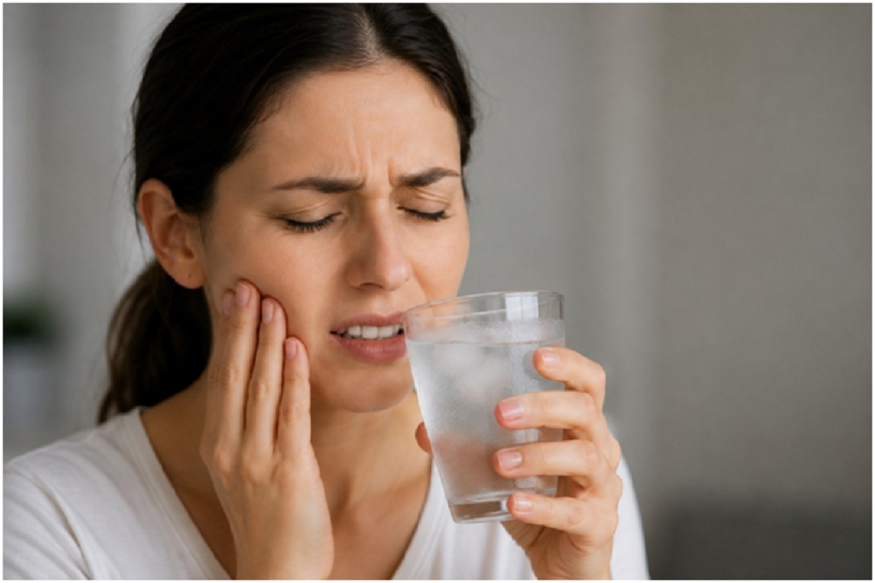
Most people meet tooth sensitivity the same way. A mouthful of iced water on a hot day, a sharp jolt through one tooth, then nothing. It passes in seconds. You make a mental note to chew on the other side and forget about it by the afternoon.
That reaction is understandable and it’s also how a lot of straightforward dental problems turn into complicated ones. Sensitivity isn’t a condition in itself. It’s a symptom, and depending on what’s causing it, the appropriate response ranges from changing toothpaste to booking an appointment this week.
The trouble is that all sensitivity feels roughly the same from the inside. Sorting out which kind you have takes a bit of attention to the details most people never think to notice.
What’s actually happening in the tooth
Under the enamel sits dentine, and dentine isn’t solid. It’s threaded with microscopic tubules that run from the outer surface inward toward the pulp, where the nerve lives. There are tens of thousands of these tubules per square millimetre, and they’re filled with fluid.
Read More: Common Dental Problems and How to Prevent Them
When dentine is exposed, temperature changes make that fluid move inside the tubules. The movement stimulates nerve endings at the inner end. Your brain interprets the signal as a short, sharp pain, even though nothing has touched the nerve directly.
This explains a lot about how sensitivity behaves. It’s why cold provokes it more reliably than heat, why the pain is sharp rather than dull, and why it stops almost immediately once the stimulus is gone. It also explains why sensitivity can appear suddenly in a tooth that felt fine last month. Dentine only needs to become exposed; nothing has to break.
The clinically useful question is what exposed it.
Gum recession
The most common cause, and often the least alarming.
Enamel covers the crown of a tooth but stops at the gumline. Below that, the root is covered by cementum, which is far thinner and wears away readily. When gums recede, root surface is exposed and dentine is essentially open to the mouth.
Recession happens gradually. Contributing factors include brushing too hard or with a hard-bristled brush, gum disease, grinding, and simple age. Most people don’t notice it happening because it takes years.
The tell is location. Sensitivity from recession usually affects several teeth on the same side, concentrates right at the gumline, and responds to cold air as much as cold liquid. Breathing in sharply on a cold morning is a classic trigger.
This type generally responds well to conservative treatment: a desensitising toothpaste used consistently for a few weeks, a switch to a soft brush, and adjusting technique. Fluoride varnish applied professionally helps too. Recession itself doesn’t reverse, but the sensitivity usually settles.
Early decay
Different pattern, different urgency.
Decay creates a physical breach in the enamel, and once it reaches dentine, the tubules are directly connected to bacteria and everything you eat. Sensitivity from decay tends to be one tooth, not several. It’s often worse with sweet things than with cold. And it doesn’t improve with desensitising toothpaste, which is the single most useful piece of self-diagnostic information available to you.
The complication is that decay frequently starts between teeth, where the contact points sit. That surface is invisible in a mirror and unreachable with a brush. It shows up on a bitewing X-ray as a small dark wedge in the enamel, which is why routine radiographs matter even when everything looks fine.
Caught in enamel, decay may need nothing more than fluoride and monitoring. Caught in dentine, it’s a filling. Left until it reaches the pulp, it’s root canal treatment and a crown, at roughly ten times the cost and across several appointments.
Cracks
The most difficult category to diagnose and the one most likely to be dismissed.
Teeth crack from grinding, from biting something hard, from the accumulated stress of large old fillings that leave the remaining tooth structure thin. A crack can run through enamel into dentine without being visible to the naked eye and without showing on an X-ray, because the crack plane sits parallel to the beam.
The signature is different from other sensitivity. Cracked teeth typically hurt on release of biting pressure rather than during the bite. You chew something, and the pain arrives as you let go. Cold sensitivity often accompanies it. Symptoms come and go, which is why people wait.
Waiting is expensive here. A crack confined to the crown of the tooth can often be managed with a crown that holds everything together. Once it extends below the gumline into the root, the tooth usually can’t be saved.
Grinding and enamel wear
Sleep bruxism wears enamel down across the biting surfaces, and enamel doesn’t regenerate. Thin enough enamel means dentine is closer to the surface, and sensitivity follows.
The signs are recognisable to a clinician: flattened cusps where there should be ridges and grooves, wear that doesn’t match the patient’s age, sometimes fine vertical cracks in the enamel. Most people who grind have no idea they do it, since it happens during sleep. What they notice is morning jaw stiffness, headaches that fade by mid-morning, or a partner mentioning the noise.
A custom occlusal splint protects what’s left. It doesn’t restore what’s gone, which is the argument for dealing with it early rather than after another two years of wear.
Erosion
Acid dissolves enamel chemically rather than mechanically, and the sources are often things people consider healthy. Citrus, sparkling water, sports drinks, wine, and vinegar-based dressings all sit low enough on the pH scale to soften enamel.
Erosion produces generalised sensitivity across many teeth rather than one, and it gives enamel a distinctive smooth, slightly glassy appearance that dentists recognise immediately.
One practical point that surprises people: brushing straight after something acidic makes it worse, because you’re scrubbing softened enamel. Waiting thirty minutes, or rinsing with water first, is meaningfully better.
Reading your own symptoms
A rough guide, and it is rough, because these categories overlap.
Several teeth, at the gumline, cold air triggers it, improves with desensitising toothpaste over a few weeks: most likely recession. Manageable, worth mentioning at your next appointment.
One tooth, sweet things provoke it, no improvement from desensitising toothpaste: possible decay. Book an appointment.
Pain on releasing a bite, comes and goes, one tooth: possible crack. Book an appointment, and mention the biting pattern specifically, since it directs the examination.
Lingering pain that continues after the cold is gone, especially throbbing or waking you at night: the pulp is likely involved. This is urgent.
That last distinction matters more than any other. Sensitivity that stops within seconds suggests a reversible problem. Pain that lingers for thirty seconds or more suggests the nerve is inflamed beyond recovery, and the treatment options narrow considerably from that point.
What an examination adds
Self-assessment gets you partway. Diagnosis takes tools.
A dentist will test the tooth’s response to cold in a controlled way and time how long the response lasts, tap it to check for inflammation around the root, use a bite stick to isolate cracks by loading individual cusps, measure gum pocket depths to assess attachment loss, and take radiographs to look between teeth and at bone levels.
The equipment matters here. Digital X-rays deliver lower radiation than the older film systems and allow immediate review. For complex cases, CBCT scanning produces a three-dimensional image that reveals things a flat radiograph can’t. Practices that handle root canal treatment and implants in-house, such as Appin Dental Surgery near Picton, typically have this imaging available, which shortens the path from symptom to answer.
Continuity helps too. A dentist who has watched your teeth over several years spots change far faster than one seeing you cold, because they know what your mouth looked like before.
The window you’re in
The reason sensitivity deserves attention isn’t that it’s dangerous. Usually it isn’t. It’s that sensitivity tends to arrive during the period when the underlying problem is still cheap and simple to fix, and it tends to fade as the problem gets worse.
Decay that reaches the pulp often stops hurting once the nerve dies. Patients read that as recovery. It isn’t, and by then a filling is no longer an option.
The Australian Institute of Health and Welfare reports that around three in ten adults avoid or delay dental care because of cost, which is understandable and also the mechanism by which small bills become large ones.
Read More: Understanding the Benefits of Root Canal Therapy
So if cold water has been catching you out for a few weeks, note which tooth, note what triggers it, note how long it lasts, and mention it at your next appointment. That information takes ninety seconds to gather and it genuinely changes what the examination looks for.
Sensitivity is your teeth telling you something early. Early is the useful part.